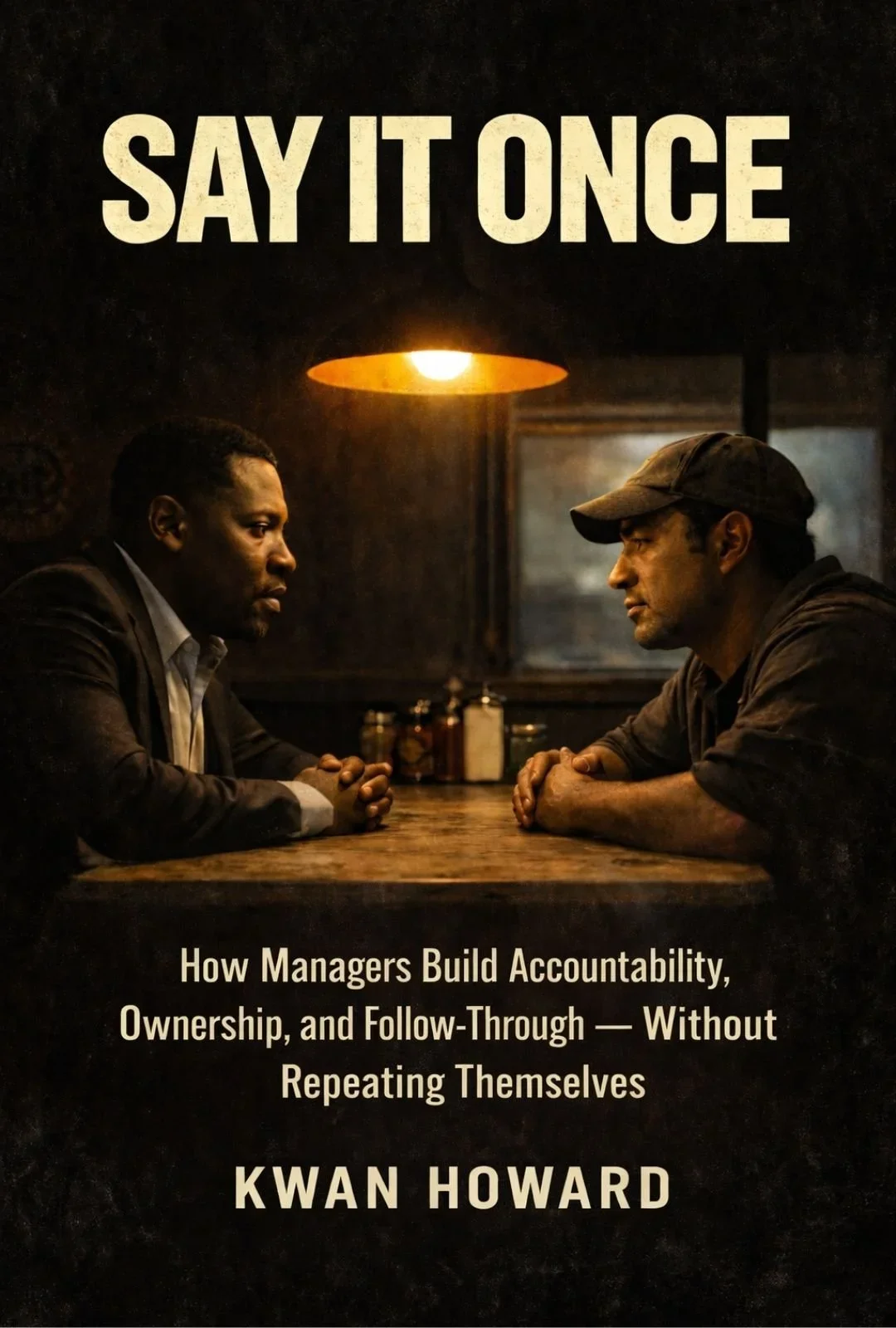
Say It Once
How managers build accountability, ownership, and follow-through — without repeating themselves
About the book
Say It Once will teach you how to stop chasing your team and start getting follow-through the first time.
Tired of having the same conversation with the same people about the same problems — only to come back a week later and find nothing changed?
You explained it. You reminded them. You followed up. Maybe you've even thought, it would be easier if I just did it myself.
Instead of pushing harder, Say It Once shows you how to figure out why the work isn't getting done before you try to hold someone accountable.
Using the simple AAA Framework — Awareness, Ability, and Agreement — you'll learn how to identify what's missing, fix the right problem, and know what to do next.
So you can build a team that knows what's expected, owns the work, and holds the standard — even when you're not in the room.
The AAA Framework
Three conditions have to be true before you open your mouth
Every accountability conversation that falls apart falls apart because one of these was missing. Once you know which one, you know exactly what to do next.
Awareness
Did they actually know?
Delivering information isn't the same as confirming awareness. Until someone can show you they understand what they own, it isn't there yet.
Ability
Can they actually do it?
Knowledge, skill, resources, and an environment that isn't working against them. A gap in any one means they can't execute, no matter how willing they are.
Agreement
Have they explicitly committed?
A nod is not agreement. "I'll try" is not agreement. Agreement is a clear yes — and until you have one, accountability hasn't been established.
Contents
What's inside
Opening
Part One — The Foundation
Part Two — The Three Conditions
Part Three — When It Breaks Down
Part Four — Building the Habit
Closing
What managers are saying
From leaders running the business
It worked like a charm. And not only did it work — it was easy.
It's usually like pulling teeth for me to get people to do stuff. That was so easy.
This has been game changing for me. I want all my GMs to know it. In fact, all GMs need to know it.
Say It Once is a provoking book that inspires individuals to communicate properly.
You take every concept and break it down to where it's easy to understand and apply in everyday life.
And just for the record, you cannot just read it one time if you're truly trying to improve.
Overall great read. AAA.
I don't think anybody talks to us like this.
Leadership classes haven't helped us. Nobody's giving me the tools or saying, "Here's what you should look at and here's how you do it."
You're actually breaking it down and giving us what we should really be doing.
It's informative. The examples are good.
This right here kind of streamlines the process.
Now I have the ability to make an impact.
The difference between thinking you're impactful and knowing you're impactful is different.
Everybody's going to learn this and be like, "How do we do this? I've got to start learning it."
I truly, truly am a believer.
The companion tool
Want to know where your follow-through is breaking down?
The book gives you the framework. The AAA Accountability Diagnostic helps you apply it to your own management. Answer 20 questions and find out whether your biggest breakdown is Awareness, Ability, or Agreement — and what to fix first.
About five minutes · Instant results · Free
Responsible for multiple stores?
Say It Once gives you the foundation for creating accountability and follow-through with your team. If you're a District Manager who wants to go further — and build management teams that can run their stores the way you would, without you having to be there — discover Every Store. Best Store.
Say It Once
Stop chasing. Get follow-through. Build a team that holds the standard without you in the room.
Introduction
Why the conversation keeps failing
Marcus had been having the same conversation with the same general manager for three weeks.
Not a similar conversation. The same one. Same issue, same back and forth, same ending where the manager nodded and Marcus walked away thinking something got resolved. Then the next week it wasn't. And the week after that.
Marcus wasn't a bad leader. Eight years as a DM. He knew his stores, knew his numbers, knew how to run a market when things got tight. But this — the people side, actually getting someone to hold a standard — felt like pushing on a wall that never moved.
He brought it up with Rosa Medina during a portfolio review. She didn't say much at first. Just asked him one question.
"Before that conversation — did you actually confirm he knew what was expected of him?"
Marcus paused. "I told him."
"That's not what I asked."
That's where this book starts. Not because it's a big dramatic moment — it isn't. But because it nails the problem. Marcus told his manager what was expected. He figured the telling was enough. It wasn't. And because the foundation wasn't there, every accountability conversation he tried to have went nowhere.
The introduction continues in the book.
Prefer to listen? The audiobook comes with five field tools for putting it to work.